
Under Review: Wordly Girls by Tamara Jong
By Selena Mercuri
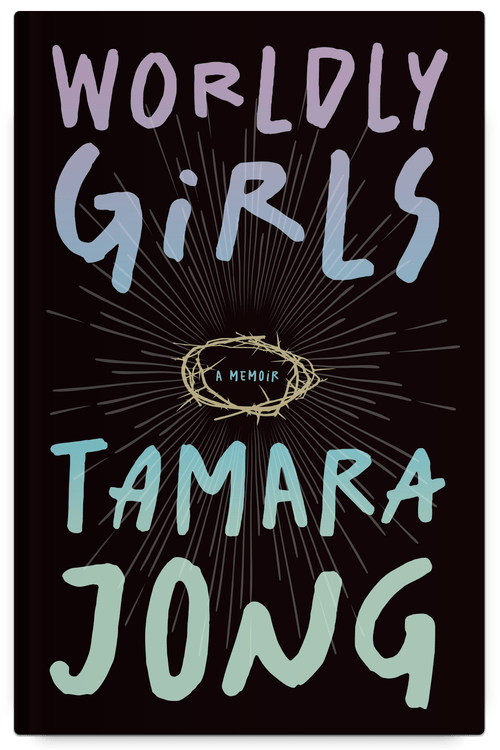
Tamara Jong’s debut memoir, Worldly Girls, is like an archaeological dig through the sediment of abandonment—parental, spiritual, cultural—that accumulates in a life lived between worlds. The book’s title derives from Jehovah’s Witness terminology—“Worldly” refers to those outside the faith who pursue “materialism, higher education, and fleshly desires.” Jong reclaims this loaded term with characteristic irony, positioning herself and her female relatives as complex beings who are not easily categorized. In so doing she demonstrates the ways that religious language can shape and distort our understanding of ourselves and others.
The emotional gravity of this collection centres on Jong’s relationship with her mother, Alexandra, whose death by drowning in Cancun when Jong was twenty becomes an absence, yet also a haunting presence. Alexandra emerges as a figure of complexity—a Nova Scotian farm girl who fled abuse at twelve, found temporary refuge in religious conversion, battled alcoholism, and was ultimately excommunicated by the very community that had offered salvation. Jong’s relationship with her mother had been severed by religious doctrine years before Alexandra’s death; as a disfellowshipped member, Alexandra was shunned even by her own family.
“I think we could have been friends if we were not family,” Jong writes in the essay entitled “Leave-Taking,” addressing her mother directly. “I wouldn’t have judged you in that way only your children can.” This imagined friendship haunts the narrative, offering glimpses of connection that doctrine made impossible. Jong recalls their final encounter—a chance meeting in a Montreal subway tunnel where both women waved despite the prohibition against contact. “I would write and rewrite this scene in the subway many times in the years that followed, but I rarely told anyone that I waved back.”
Worldly Girls approaches religious trauma through a lens of complexity rather than complete condemnation, acknowledging faith’s genuine gifts alongside its costs. Jong expresses genuine appreciation for the community that raised her, the sense of purpose that sustained her through adolescence, and the safety that religious structure provided in a chaotic household. When her parents divorced and her father effectively abandoned the family, Jehovah became a substitute father figure.
Jong’s exploration of mixed-race identity feels equally complex and urgent. “When you’re mixed-race someone’s always telling you who you’re not,” she observes. “People ask if I’m Chinese, what I am, where I’m ‘from.’ If I tell them I’m from Montreal, they say, ‘No, before that.’” Her father’s revelation that he was a “paper son” with false documentation that allowed him entry into the country adds another layer to her questions of belonging, making her own sense of cultural inheritance even more precarious.
The memoir’s handling of fertility struggles and step-parenthood demonstrates Jong’s ability to find fresh language for well-travelled emotional territory. Her account of trying to conceive at forty-six avoids both saccharine optimism and bitter cynicism, often incorporating imagined conversations with an unconceived child she names Hans-Peter. When the fertility doctor delivers bad news—low ovarian reserve, poor egg quality—Jong writes simply: “The dream was not a portent after all.”
Jong possesses a gift for specific details that reveal the power of acute observation: her mother’s false teeth grinning from a bedside glass, the satisfying sound of dirt being sucked up by a vacuum cleaner, the crack in the blue pail used for hair-washing. These concrete images help anchor even the most abstract discussions of faith and identity.
The memoir’s treatment of place feels equally precise. Jong’s Quebec childhood emerges through vivid specifics, such as the view of the Soeurs de Miséricorde convent from their apartment balcony, Chinese double features at the Cinema Electra, the walk across Pont Lachapelle to avoid paying bus fare. When Jong returns to Montreal as an adult to visit Catholic sites, these locations carry a mix of personal and cultural significance.
Worldly Girls, instead of simply transforming trauma into triumph, serves as a realistic account of the work that goes into constructing identity from fragments of faith, abandoned doctrine, maternal absence, and chosen family. “Maybe these are just stories meant to entertain,” Jong writes. “Maybe my faith had been a mother’s gift to her daughter, a keepsake to hold on to.”
Jong’s honesty about the forms unprocessed loss can take, years or even decades later is potent. She finally fully mourns her mother twenty-five years after her death, triggered by a Buffy the Vampire Slayer episode, capturing the unpredictable nature of delayed grief. “It’s been twenty-five years since your funeral, and it’s time. I can feel the grief pushing out from its hiding place.”
The memoir’s final essays circle back to foundational questions about loss and identity. In “Grief Is a Tomato Plant,” Jong uses failed gardening as a metaphor for her father’s death and her ongoing attempts to understand origins. The discovery of her father’s second family and hidden identities doesn’t resolve questions about belonging but adds new dimensions to them. In “Weight,” Jong’s attempt to recreate her mother’s lemon meringue pie becomes a reflection on inheritance and the ways we try to keep the dead alive through ritual.
Jong’s ability to move between intimate family scenes and broader cultural critique, to balance humour with pathos, and to honour complexity without sacrificing narrative drive produces a book that operates with surgical precision on the body of memory. Worldly Girls unfolds like a series of controlled explosions, each essay detonating just enough certainty to reveal what lies beneath—the stubborn persistence of love amid doctrinal wreckage, the strange comfort found in abandoned rituals, and the peculiar freedom that comes from having nothing left to lose.

Selena Mercuri is the Reviews Editor at The New Quarterly, a publicist at River Street, and a social media associate at The Rights Factory. Her writing has appeared in The Fiddlehead, The Literary Review of Canada, Prairie Fire, and The Ampersand Review, among others. She received the 2023 Norma Epstein Foundation Award for Creative Writing and is currently an MFA candidate in Creative Writing at the University of Guelph. Find her on Instagram @selenamercuriwriter.