
Under Review: In the Field by Sadiqa de Meijer
By Danila Botha
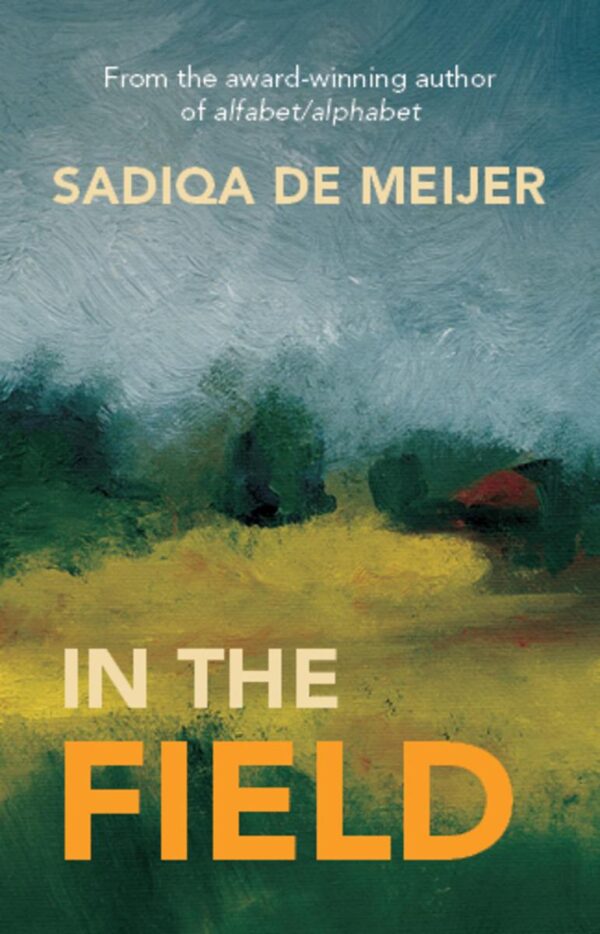
It seemed auspicious to read a book called In the Field this month—not just the month of September, but the Jewish month of Ellul, with its famous phrase “the King is in the field.” The phrase is meant to remind people that the spiritual is still accessible, that connection exists even within the framework of everyday life. Sadiqa de Meijer’s writing is sublime, and this collection of essays, from the Governor General’s Award-winning author of alfabet/alphabet is stunning. De Meijer’s writing is always lyrical and evocative, a perfect mix of poetry, introspection, and philosophy. In these essays, de Meijer wrestles with questions of cultural identity and displacement, familial expectations when it comes to career and belief, and balancing motherhood and life as an artist, among many other things.
De Meijer does incredible work with the form; her writing always feels authentic and beautifully curated, but unhampered by a linear sense of time or any expected modes of essay writing. Every essay should be savoured on its own, and yet together they read as beautifully cohesive, sharing an ethos of swerving and subverting readers’ expectations to reveal new insights. In the opening essay, “The Singing Bone,” she explores both familial and cultural myths, race, Christianity and Islam, the Netherlands, Nairobi, and Canada, interwoven with precisely rendered and affecting moments from her childhood.
“Found” describes the experience of losing a cherished notebook, full of “things I thought, or saw or overheard—whatever seemed to matter, even though I couldn’t yet say why…those years held bright and profound experiences, and they also made me feel that I might prove to be a writer only in my own mind. My notebook then was the small but reliable dwelling where my potential self could live.”
In “Bloodwork,” she describes her experiences in medical school, full of quotes by James Baldwin and Elizabeth, the tension between wanting to please a father whose voice grew animated, “the glaze gone from his eyes” when she told him as a child that she wanted to be a doctor, versus the acute sensitivity and perspective of her artistic self. In “Dwaallichtes,” she returns to themes of displacement and belonging, which she articulates in a way I could relate to deeply: “I was born here, I’ve returned to study a feeling.”
In “After Etty,” she writes about Etty Hillesum, a complex and fascinating Dutch Jewish writer killed in the Holocaust, whose posthumously discovered diaries moved her. De Meijer writes every sentence with profound empathy and thoughtfulness, as in her description of Hillesum’s work: “Writing is a translation of our attention, and Etty’s possessed such presence that even within a nightmare, she could see a world.” Like Hillesum, de Meijer always maintains a deeply felt sense of hope, with both the essay and the collection ending with the luminous line: “All I can do is fill my pockets with the dark and rustling pods, to plant when I get home.”
In the Field by Sadiqa de Meijer
Palimpsest Press, 15 October 2025
176 pages
$21.95
Danila Botha is the author of three short story collections, Got No Secrets, For All the Men (and Some of the Women I’ve Known) and Things that Cause Inappropriate Happiness. Her novels include Too Much on the Inside and A Place for People Like Us. Her first graphic novel will be published in 2026.