
Finding the Form with Anthony Purdy
I think of it as a spandrel – that unloved space under the stairs in some houses – but of course it’s really my head, where all manner of things have rattled around for decades. Bits and pieces, odds and ends, things that were sure to come in useful one day if only you could remember what they were. As well as material objects, there are enough images to fill the Cloud, and a chaotic audio file, too: snatches of songs and poems, of overheard conversations that left a warm glow or an indelible bruise. Now and again, two or more of these memory fragments will rub together in a dream or daydream, and the juxtaposition will give rise to a new form. So it was with “When an Old Man Dies,” born as I slept when two memory fragments stumbled into one another in the dark. 
The first was a quote from Amadou Hampaté Bâ, who once said: “un vieillard qui meurt, c’est une bibliothèque qui brûle.” In English translation, the French tumbled artlessly into iambic pentameter – “When an old man dies, a library burns” – the first indication that what was taking shape in my head was a poem rather than a story. It’s many years since I first came across Bâ’s claim that, in an oral culture, social memory requires repositories of flesh and blood rather than archives or libraries. I was working closely at the time with several survivors of the Rwandan genocide, and the affective bonds I formed with them must have played a part in my unconscious registering of the statement, which was to become an unacknowledged cornerstone of my thinking on cultural memory and transmission.
The second was from a short parable by Jorge Luis Borges, “The Witness,” which I have known since my student days. Less than a page long, it imagines a hypothetical last Saxon, standing on the threshold of a dwelling and on the cusp of seismic cultural change – the passing of one world and the birth of another. At the end of this brief meditation, the author is prompted to change register and ask the most personal of questions: What will die with me when I die?

The two fragments speak to one another in obvious ways and take on heightened resonance in our own late (or end) times, but for me to recreate the emotions I felt in the dream, I needed more than simple juxtaposition. In fact, I had to do two things: offer a personal answer to Borges’ question and extend Bâ’s African context to encompass the very different oral culture of my own early years. Both my grandfathers were coal miners, and there were no books in their homes. The grandparents I lived with for a period of my early childhood were both literate, but only because my grandmother taught my grandfather to read and write after they were married. To my knowledge, he never read a book, and my grandmother’s own reading was confined to the Bible. The poem closes in a pre-literary memory space of scent, sound, and image, in which the paradoxical figure of the non-existent library generates a piece of writing – the poem itself.
A final word on the iambic pentameter. I’m suspicious of the form because it comes too naturally to the anglophone ear and is weighted with a particular cultural tradition. Hence the decision to split the line in two, creating a tension for the first two-line stanza between eye and ear. The two-line stanzas continue throughout the poem to provide formal structure, but with variable line lengths; the iambic pentameters return only for the change of register at the end from public to personal, this time using a six/four split.
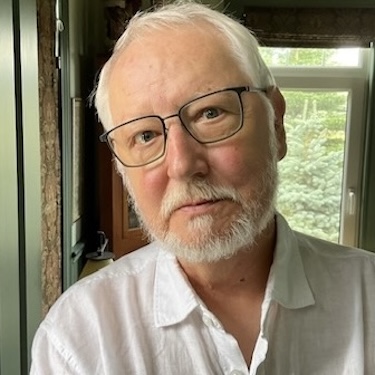
Anthony Purdy is an East Coast poet and short story writer living in Mi’kma'ki. His work has appeared widely in Canadian magazines. A chapbook, No Sound is Dissonant, was published in October 2024 with the Little Books Collective of Lunenburg, Nova Scotia.
https://spotofpoetry.com/little-books-collective/
