
Skip to content
logo TNQ
  • Read
    • Dispatches
    • Issues
    • Online Exclusives
    • Under Review
    • Free Archive
      • Poetry
      • Fiction
      • Nonfiction
  • TNQ Presents
    • Wild Writers Literary Festival
    • Writing on the Land: A Wild Writers Retreat
    • The Vestige and TNQ Story
    • Spirit Ink
    • The X-Page Workshop
    • Parallel Homepage
  • Subscribe
    • Print Magazine
    • Digital Edition
    • Free Archive
  • Submit
    • Contests
    • Regular Submissions
  • Donate
  • Shop
    • Where to Buy
  • My Account
  • About TNQ
  • Our Team
  • Contact Us
Login
$0.00 0 Cart

Alison Stevenson’s Writing Space

By Alison Stevenson

I write in various places around the house, but this is my ‘office.’ As well as writing, I keep writing-related stuff here, including notes and papers and some books I find useful and/or inspiring. I also carry out my day job here. It’s a kind of Murphy-bed set-up, in that I can sit on a chair or a ball, and the desk raises up and I can swivel everything around to the other side where there’s more space for standing. (How much do I stand? – not very.) I can close my work laptop and stack my personal Mac on top and thereby transform from mild-mannered day-job Clark-Kent-esque bespectacled person moving words around a page into the same person but moving (hopefully) more interesting words.
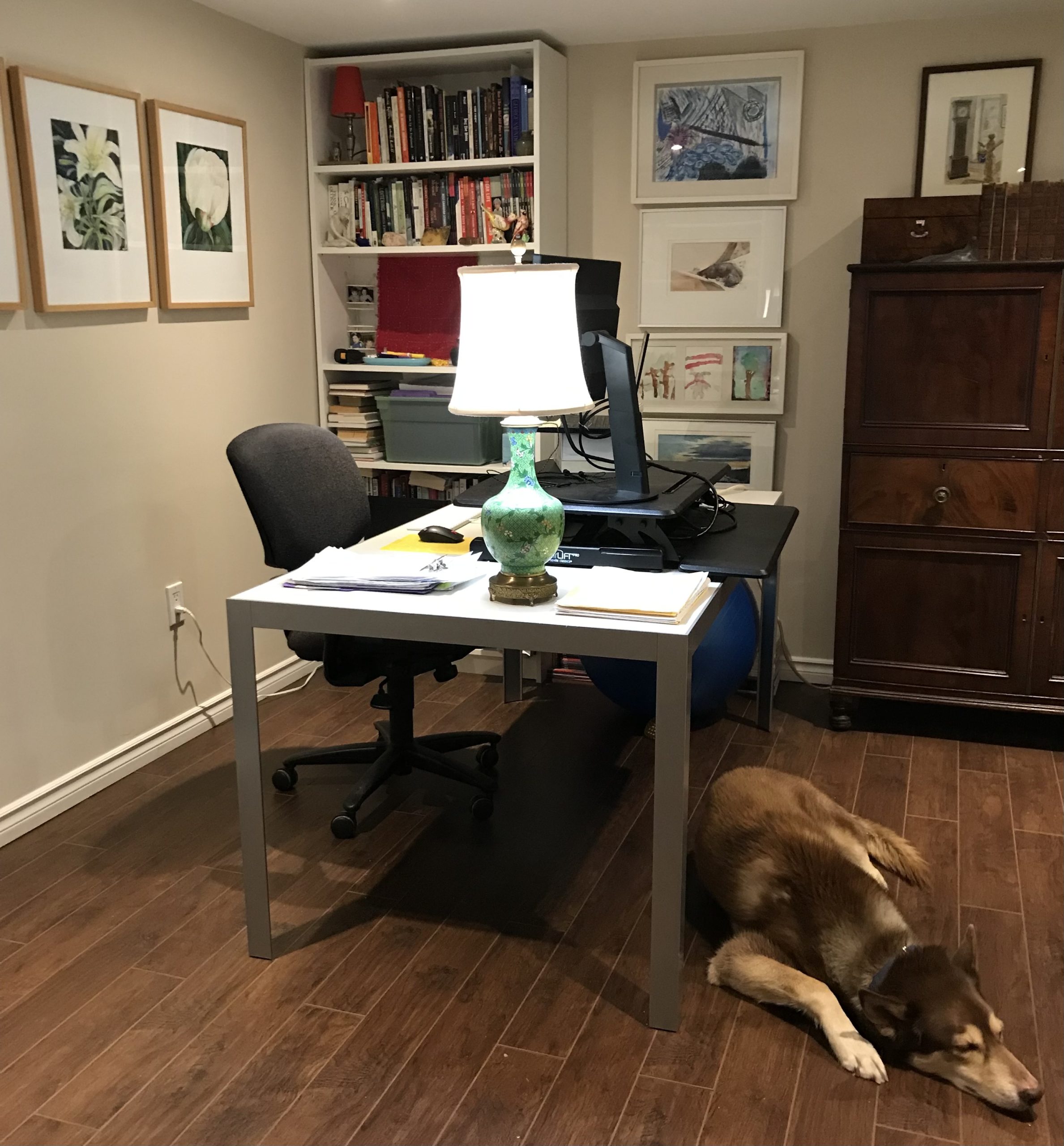


There’s no window to look out of, which is just as well, since I’d probably spend a lot of time looking out of it. Another good thing is the ergonomic set-up, which I think is crucial, given the amount of time I (like many people) spend at a keyboard.  

The artwork is by my mother,  Joyce Stevenson, and by my children when they were young. There are various other things here that please me, like sashiko embroidery from my daughter, a wooden box with a secret drawer my father made for my fourteenth birthday, a rock that looks sort of like a brain and another piece of rock with dried mould on it that looks like leaves.

I would describe myself as a slow writer – no splashing down pages of stuff and editing it later. I usually build up a story word by word, sentence by sentence, and do a lot of editing and re-editing as I go. I would say that’s reflected in my physical space by not having external stimulation from a window, or music, and by having a set-up that lets me work for long periods away from distractions.   

Alison Stevenson’s work has appeared in Prairie Fire and The New Quarterly, was longlisted for the CBC and TNQ/Peter Hinchcliffe prizes, a finalist in the Alice Munro Festival of the Short Story and was selected for the Eden Mills Festival Fringe Stage. She has attended The Humber School for Writers, U of T  School of Continuing Studies and Iowa Writers’ Workshop summer workshop. She is working on a collection.

Link

Photo by Sigmund on Unsplash

Read more

  • Alison Stevenson
  • Writer Resources
  • Writing Spaces

Post navigation

Covering and Uncovering Masks: An Interview with Terry Watada
The Best Wave and the Right Moment: A Conversation with Aaron Schneider

Territorial Acknowledgement

The New Quarterly is based in Waterloo, Ontario, on the traditional territory of the Haudenosaunee, Anishinaabeg, and Neutral Peoples. We acknowledge that this land is part of the Haldimand Tract, the land promised to the Six Nations of the Grand River as part of the Haldimand Proclamation of 1784.

As a literary magazine devoted to storytelling, we recognize that stories have long been a way of knowing, preserving, and sharing in Indigenous cultures. We honour the generations of First Nations, Métis, and Inuit peoples who have cared for these lands and continue to do so. We commit to listening, learning, and amplifying Indigenous voices, and to supporting pathways for truth and reconciliation through the stories we publish.

Facebook-f Instagram Linkedin-in Tiktok X-twitter
  • Privacy Policy
  • Accessibilty

MAGAZINE

  • About
  • Our Team
  • Where to Buy

CONTRIBUTE

  • Submit
  • Volunteer
  • Our Board
  • Donate

CONNECT

  • Contact Us
  • Newsletter

Subscribe to our Newsletter

CONNECT