
Finding the Form with Leona Theis
By Leona Theis
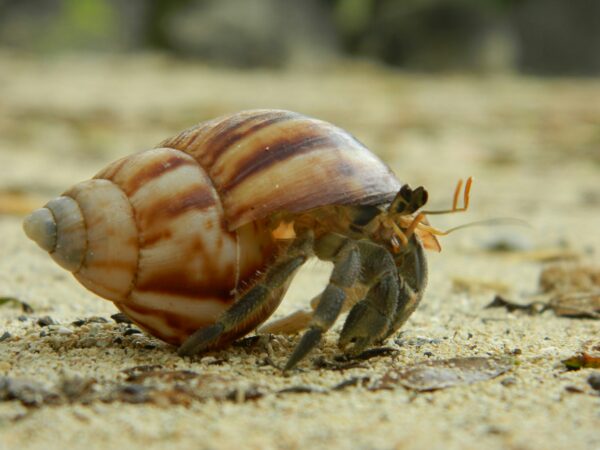
The first essay I ever wrote, twenty years ago now, took the form of what I now realize is called a hermit-crab essay, though I didn’t know this at the time. I organized my thoughts into short passages to do with my mother’s occupations throughout her lifetime. That piece was, and still is, my most deeply personal work. I followed this with an essay about my father, under the headings of a school curriculum. In the essay that appears in this issue of TNQ, “Shelter, a Personal History,” I speak directly about this way of organizing a piece, and about how, with those long-ago essays about my parents, I found my way alone and quite naturally to the form as a way to deal with emotionally difficult material. The constraint of it helps me walk around a subject in a sort of spiral, seeing it from several angles, letting deeper meanings emerge as I circle closer. It’s not surprising, then, that “Shelter,” which appears here, is itself a hermit-crab essay, describing shelters both concrete and metaphorical, one after another. This form offered me a vehicle to explore the question of whether a human being ever leaves behind their childhood home. And I literally bring the hermit crab’s own housing strategy into my exploration: throughout its lifetime, a hermit crab finds and adopts a sequence of homes,
typically shells discarded by other creatures.
Shape has always been central to my work, whether or not I’ve been conscious of that at the time. I’ve written a novel where Part 2 follows the shape of a mobile, and another novel that has the shape of a delta. Playing with shape, for me, is one of the joys of writing.
I love to work with that tension between constraint and freedom. Who knows what layering and richness this fosters, and what other richness would arise with a more loose approach? Impossible to say. I do know that for me to write an essay at all, I need, at some time in the process, to impose some sort of constraint, and then explore within it. Almost every chapter in my forthcoming memoir has an organizing principle to do with form, be it a rope-twist, a braid, an abecedary, or a set of hermit-crab headings.
Leona Theis’ most recent novel is If Sylvie Had Nine Lives, and her memoir Chance after Chance is forthcoming with Thistledown in 2027. She lives on Treaty 6 territory in Saskatoon.