
What is Ian Roy Reading?
By Ian Roy
In the early days of the pandemic, back when everyone was baking bread and doing puzzles, a friend on social media tagged me in one of those ‘name-ten-books-that-changed-your-life’ posts. I usually ignore these things because they make me anxious. Just ten? Changed my life how? And they usually instruct one to simply post the cover with no further explanation. Like that was going to happen.
I ignored it for a few days, but of course I was left thinking about which books I would include on such a list. I eventually decided to play along. It was fun to revisit a handful of books that I have loved and that have stayed with me over the years. Judy Blume’s Then Again Maybe I Won’t (a classic that I will always love) made the list, as did Margaret Laurence’s The Diviners (a novel that contains perhaps the best cuss in all of literature). At the top of the list was Alistair MacLeod’s The Lost Salt Gift of Blood, an absolutely perfect collection of stories (I won’t even qualify that with an “in my opinion”).
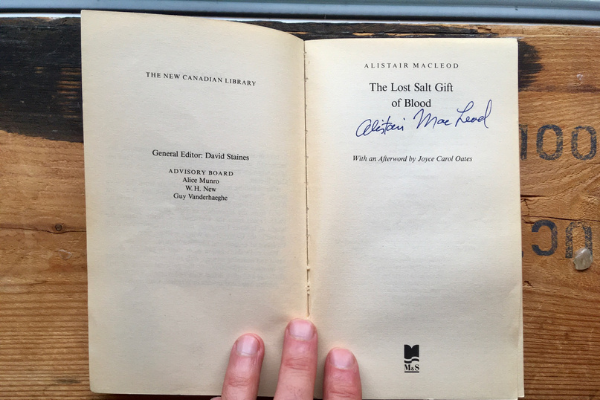
I can’t take that Alistair MacLeod book off my shelf and not reread it. So that’s just what I did.
I love the title of this book. I remember the first time I saw it in a bookstore. I read the title out loud several times, causing customers and staff alike to keep an eye on me, no doubt. What does it mean? I wondered (and probably also said aloud). What could it possibly mean?
So much, it turns out.
Part of what MacLeod’s fiction is about is slowing down and simply telling a good story. His voice—his literary voice—is so conversational, so casual, you can’t help but be drawn into his stories. And his sentences… they appear so effortlessly perfect, so precise. I once typed out an entire story from this collection (“The Boat”) just to see how it worked on a word by word, sentence by sentence level. Every single word in every one of his stories is crucial, is necessary: there is nothing on the page that shouldn’t be there, that doesn’t move the story forward. I learned to slow down (as a writer) by reading his work; I learned to trust the story and let it unfold.
The first time I read this book, I was living in Halifax. I heard that Alistair MacLeod would be reading at the old library on Spring Garden Road. I told my boss I had a doctor’s appointment and ran across town to catch the reading. MacLeod read a story from The Lost Salt Gift of Blood and talked a little about writing. It was fantastic. Afterwards, someone in the audience asked for writing advice. In a deep, commanding voice, MacLeod said two words: Don’t obfuscate. And then he laughed. It was a wonderful laugh.
Ian Roy is the author of four books, including his most recent collection of stories, Meticulous, Sad, and Lonely. He is currently working on a novel for children.
Photos courtesy of Ian Roy and Hans-Peter Gauster.