
Finding the Form with Kari Lund-Teigen
By Kari Lund-Teigen
Reading it now, it strikes me that The Octopus feels like a pandemic story. Not about a pandemic, but emerging out of the conditions familiar from it: the isolation, the octopus from the Netflix documentary everyone’s watched, the sourdough bread! But the first draft emerged in the winter of 2017-2018. The spark for this story was an absorbing book by Sy Montgomery called The Soul of an Octopus. I love to read this kind of nonfiction when I need a reminder of all that is amazing and beautiful in the world.
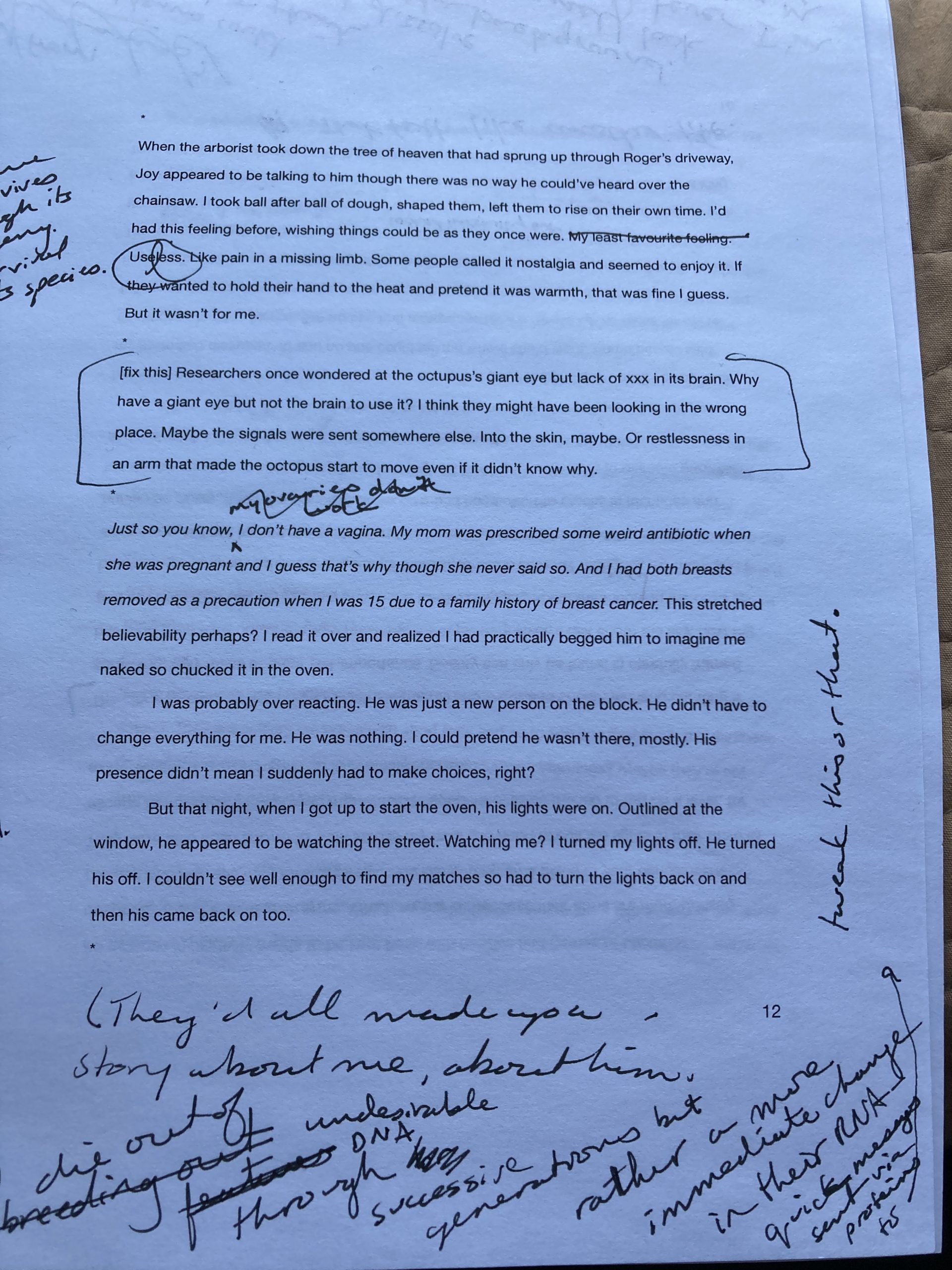
A first draft, for me, drifts into place through what I hesitate to call a process. I don’t mean to make it sound mystical. It really is just putting pen to paper when something occurs to me: a sentence, sometimes a whole paragraph, bits of dialogue. I don’t feel like I know what I’m doing or where it all comes from. It’s not often I look back on finished stories to figure it out.
“It really is just putting pen to paper when something occurs to me: a sentence, sometimes a whole paragraph, bits of dialogue.”
In addition to the obvious fascination with octopuses, I can look back now and see other threads connected to my life at that moment. We’d just moved across the country and I was in the middle of my first “real” winter in almost a decade. I missed my old neighbours. I missed the ocean. I was worried, as always, about the future. And I was thinking, as always, about stories.
In subsequent drafts, I cut a lot, mostly background. Where are they? What happened? Those details were important for me to write the story, but weren’t important enough to include for the reader. Next, I had to make the connections between adjacent ideas more concrete. This took time. I’d work on it, put it away for a while, then work on it again. The story slowly settled into place.
Yesterday, I read an article in the New York Times about how whales manage to take in enormous quantities of water without choking. It turns out they have a special plug that moves into place. In the endless grind of disheartening news, I’m grateful for information that leaves me awed and humbled. So far, no story involving whales is brewing. But I do have a book about eels that I haven’t started reading yet, so who knows.
In addition to TNQ, Kari Lund-Teigen’s writing has appeared in Glimmer Train, The Fiddlehead, Prairie Fire, and Grain. You can listen to her read at drumlitmag.com. For more, visit karilundteigen.com.
Photo by Serena Repice Lentini on Unsplash