
Finding the Form with Susan Glickman
By Susan Glickman
I am an early riser and love observing the world waking up around me. There is nothing more beautiful than the dawn chorus of birds except, perhaps, the mist rising off a cold lake as the summer day begins. It has always seemed magical to me, embodying a fleeting moment when the seen and unseen worlds are closest and the true nature of things is about to be revealed.
When I was a child, my parents rented a cottage every August on Lac Ouareau near St-Donat; when I was an adult, they bought one on Petit Lac Ouimette near St-Sauveur. My parents are long gone and with them that beloved place but luckily for me, my brother David has a chalet on Lac Black near Lachute that he graciously lets me use. Here is a painting I made of the view of the lake from his dining room window.
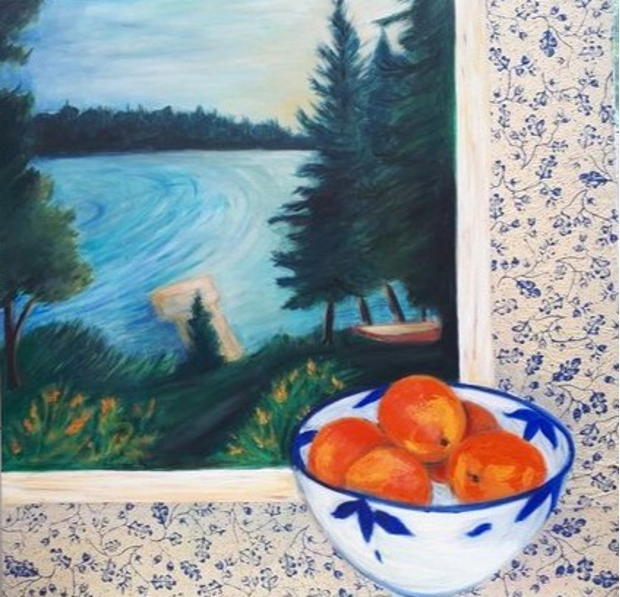
A few summers ago I was standing on the dock you can see in that painting, contemplating the morning mist and thinking that I really ought to write a poem about it. I didn’t, but the impulse lodged somewhere inside me and persisted, nudging me gently from time to time. Eventually it forced me to engage with it. I knew this was going to be a long poem. I knew it was going to have many sections. I suspected all the sections would have the same structure. But I didn’t know what the poem would be about except for its opening image, nor what actual form it would take.
The next time I stayed at my brother’s cottage, I went with the express purpose of writing that poem, mainly so I could find out why I was so obsessed with writing it! (This is often how poems take hold of me: some image, or rhythm, or phrase, takes hold of my imagination and won’t let go until I give it my full attention.) One early morning, coffee at my elbow, everybody else fast asleep, I typed “At Dawn, the Mist” at the top of a page. I immediately recognized that it was not only the first line of the poem but also its title. That awareness lead me directly into the next two lines:
At dawn, the mist
rises from the lake like its muted reflection
or inchoate thought not yet made manifest in language.
I tarried here a while, waiting for my mind to catch up with where the poem was going, and then arrived at:
The lake is thinking, I think, observing it;
whether it observes me back, I’ll never know.
At that point I had four sequential lines and anticipated writing more to complete a long verse paragraph. But as I sat with the quatrain it started to strain in the middle, wanting a longer pause between the end of line 2 and the opening of line 3 to allow time for “thinking” to take place. And then – once I realized that I might, in fact, be writing in couplets – I didn’t want to end the second couplet with a period the way I had ended the first one, because these weren’t ghazals but part of an unfolding revelation. In other words, I still wanted the amplitude and sense of opening out to the world I associated with free verse even though I was apparently going to be writing in tidy segments of two lines each.
To honour that sensibility, I deleted the period after “know” and carried on with a word that rhymed with it at the same time as it challenged it semantically: “though.” This word served as a kind of hinge that brought the focus of the poem from me pondering the lake to the lake considering me, and back and forth and back and forth we went merrily for the rest of the stanza:
though it seems unlikely, given how deep and black and cold the water is
and how I am just another mid-sized mammal hugging myself
on shore. If I were braver, if it were warmer, I might
jump in; might align my thoughts with whatever it is
the lake ponders, might find in the mist a new language
for this half-formed world that, as yet, has
no people in it.
When I arrived at this final line, I realized that I wanted to stop there: to end with a single line just as I had begun with a single line, defying the constraint of the couplet form I seemed to be committing myself to. And as I continued writing the poem, I discovered that just as I had made the title the first line of the poem, so too would I make the last line of each section the first line of the next!
I was, indeed, “finding” the form rather than imposing it. It emerged organically during the writing process.
However, figuring out how to indicate this form on the page took some thought. I couldn’t just hop over the white space between stanzas and expect readers to make the same connection I did, so I decided to repeat the last line, setting it in bold type to make it clear it was doing double duty as both title and first line. This is pretty obvious on paper, but the first time I read “At Dawn, the Mist” to some friends, they thought I was getting confused and repeating myself accidentally, and this confusion interrupted their listening long enough that they missed some of the poem. So now, whenever I read it out loud, I explain its form in advance!
Of course, the poem I finished after two weeks at my brother’s cottage was not really “finished”; I continued to tinker with it for another eighteen months. But it was just a matter of fine-tuning individual sounds and pauses and rhythms once the form had been found.
Susan Glickman is the author of 8 books of poetry, most recently Cathedral/Grove (2023), 4 novels for adults, 3 novels for kids, a selection of essays and a work of literary history.