Under Review: The Fall-Down Effect by Liz Johnston
By Aviva Rubin
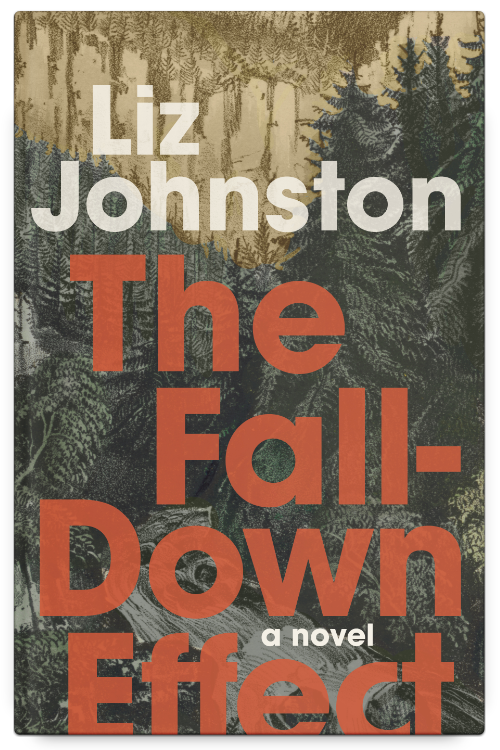
Should commitment to fighting the multinational interests plundering the planet and driving climate change allow anyone to put family at risk? This question lies at the heart of Liz Johnston’s debut novel The Fall-Down Effect—a forestry term for the significant reduction in timber harvest when shifting from old-growth to second-growth forests. It’s a compelling, timely, poignant, and occasionally frustrating exploration of what happens when convictions and beliefs bump up against family ties, love, and obligations. I say “frustrating” because I occasionally found myself wanting to yell, “don’t make that stupid, irreversibly-damaging choice.” Johnston herself doesn’t moralize. She is neither judge nor arbiter. The characters and the reader must work through the long-term ramifications of choices, tensions, loyalties, and where value ultimately lies.
Spoiler alert: there are no quick fixes, right answers, or aha moments.
The family story unfolds over three distinct timelines: 1989, 2003, and 2020. We learn that back in the mid-eighties parents, Tom and Lynn, left an environmental activist student life in Vancouver and moved to the interior of British Columbia to raise a family. Lynn home-schools their three children, while Tom works as a Park Ranger. Johnston doesn’t make us wait to understand what is at stake. Lynn’s rage and resentment over that choice, and what she lost in the process, are evident from the get-go. She arrives home hours late from her one-person protest against a McDonald’s opening in town, having left her eleven-year-old Sylvia in charge of seven-year-old Fern and six-year-old River. “We used to have a purpose, Tom,” she complains, as her husband prepares the dinner she should have made.
An occasionally disconcerting, ever-shifting point of view—sometimes sentence by sentence—gives us a clear picture of each child: Sylvia, a frustrated conformist who feels responsible for her siblings; Fern, the stubborn angry rebel and early naturalist who can’t accept opinions that differ from her own; and River, the artist who seeks peace but is easily frightened and thrown off course. They are wonderfully captured in the details: River ranking his favourite cakes to avoid listening to an argument, and the unstoppable Fern running around the table repeating a phrase. At a tense and messy “family dinner,” Lynn justifies her decision to protest. Tom tries to avoid fighting with his wife in front of their children, and Sylvia moves the little ones inside to spare them the harsh words.
Transparently self-serving and blind to her own motivations, Lynn repeatedly convinces herself she is choosing the righteous fight for the planet, even as she fantasizes about leaving her family to reunite with a lesbian lover. In thinking about what having children has done to her “delicate and quivering” husband, Lynn speculates: “All that mattered now was the kids. Not the world the kids grew up in. Not the air they’d be unable to breathe in a few decades if things kept going at this rate.” Her beliefs and disappointment constantly get in the way of putting her children first. But what’s more important?
The insular and tenuous family life cracks entirely after Lynn engages her children in a risky but seemingly pointless blockade of a new logging road. Shortly after this, the kids are sent to school. While proud of the ways in which Fern takes after her, Lynn tells herself it is best for everyone if she leaves. Fern and Sylvia viciously blame each other for their mom’s decision, and River is traumatized by thoughts of a toxic rotting monster in his room as his mother drives away without saying goodbye.
The family is shattered a second time twelve years later. The three children, already disconnected and on their own paths, are further forced apart after Fern’s own radical act drives her into hiding. Weeks before her planned action, she says to River, “I spend so much of my life angry that no one’s paying attention, right? If they are, then they don’t know what to do about shit. Or they’re like mom and it’s all about ego.” It turns out she has never seen her mother as a model to follow.
While the family knows it was Fern as soon as they hear the attack reported on the radio, and do what they can to protect her, they almost never speak of her again. The silence is stunting and brings its own suffering and emotional consequences, which Johnston captures profoundly. Soon after Fern flees, Sylvia and River visit their mom and her wife Irene. Lynn explains why she left the family. “I was living in that small, small-minded place…” River warns her to be careful who she is seeking sympathy from, and Sylvia says, “You’re talking about your small life to the people you think made it small.” Then she outright blames her mother for Fern’s choices.
A reckoning of sorts only comes twenty years later, during the first summer of the Covid-19 pandemic, when forest fires are engulfing parts of British Columbia—a painful and apt metaphor. The Fall-Down Effect is itself a slow burn, posing fundamental questions that have no clear answer. What constitutes selfishness? What does it mean to take responsibility? What can we do in the face of destructive powers beyond our control? Is it possible to rise above the both smothering and embracing hold of family narratives? The novel, examining the nature of survival—personal and environmental—is both small and epic. Through tight and relatable dialogue, Johnston captures deeply entrenched family dynamics and profound truths about relationships. Ultimately, it is about unavoidability, disappointment, how long it can take to figure shit out, and how our connections to others can, despite the fall-down effect of being felled by family trauma, allow us to grow and flourish around the hard bits.
The Fall-Down Effect by Liz Johnston
Book*Hug Press, April 21, 2026
346 pages
$24.96
Aviva Rubin is a Toronto-based writer of memoir, essays, social commentary, and fiction. Her work has been featured in the New York Times, The Globe and Mail, Chatelaine, Toronto Life, and Zoomer, as well as numerous anthologies. Rubin is the author of the memoir Lost and Found in Lymphomaland, a harrowing and funny trip through a cancer diagnosis and treatment. WHITE is her debut novel.